Plugging in an electric vehicle for the first time can feel like learning a whole new dialect. Suddenly, you are surrounded by talk of kilowatts, amps, panel upgrades, and EVSE units. It can feel overwhelming, but charging your electric car at home does not need to be complicated.
Think of electrical terms like a simple plumbing system: volts are the water pressure, amps are the size of the pipe, and kilowatts (kW) measure how fast the water is flowing out. Once you know how these units fit together, choosing the right charger becomes straightforward.
Here is your straightforward guide to the core EV terms every owner needs to know.
1. Volts (V): Electrical Pressure
Voltage measures the electrical potential pushing power through your home’s wiring.
- 120 Volts: A standard household outlet. Used for slow “Level 1” charging.
- 240 Volts: The heavy-duty power circuit used for clothes dryers, electric ovens, and dedicated Level 2 home chargers.
2. Amperes (Amps): Electrical Current
Amperage measures how much electric current flows through a wire at any given moment. Most home Level 2 chargers run on 30-amp, 40-amp, or 50-amp dedicated circuits. Under national electrical safety rules, continuous loads like EV chargers can only draw 80% of a circuit’s total rating. For example, a 50-amp circuit safely delivers a continuous 40 amps of charging power to your vehicle.
3. Kilowatts (kW): Charging Speed
A kilowatt (1,000 watts) measures power rate—or how fast energy moves into your battery.
- Level 1 (120V outlet): Delivers roughly 1.2 kW to 1.4 kW (~3 to 5 miles of range per hour).
- Level 2 (240V station): Typically delivers between 7.6 kW and 11.5 kW (~25 to 40 miles of range per hour).
- DC Fast Charging: Public stations delivering anywhere from 50 kW to 350 kW for highway road trips.
4. Kilowatt-Hours (kWh): Battery Capacity
While kW is your charging speed, kWh is your battery’s total capacity. Think of kWh as the size of your gas tank in gallons. If your EV has a 75 kWh battery and you are using an 11.5 kW home charger, a full charge from 0% to 100% takes roughly 6.5 hours.
As noted in industry market analyses by Cox Automotive, driver adoption continues to grow rapidly as more long-range, affordable EVs enter the market. Getting the most out of these vehicles starts with having a fast, reliable charger right where you park every night.
Key Terms at a Glance
| Term | What It Measures | Real-World Analogy | EV Context |
| Volts (V) | Electrical pressure | Water pressure in a hose | 120V (standard outlet) vs. 240V (heavy-duty Level 2) |
| Amps (A) | Current / Flow volume | Diameter of the pipe | Determines circuit size; 50A breaker yields 40A charging |
| kW | Power output (Speed) | Flow rate of water | Speed of charger (e.g., 9.6 kW fills a battery fast) |
| kWh | Total energy capacity | Size of the water bucket | Size of your battery (e.g., 75 kWh capacity) |
Getting Your Home Ready for Level 2 Charging
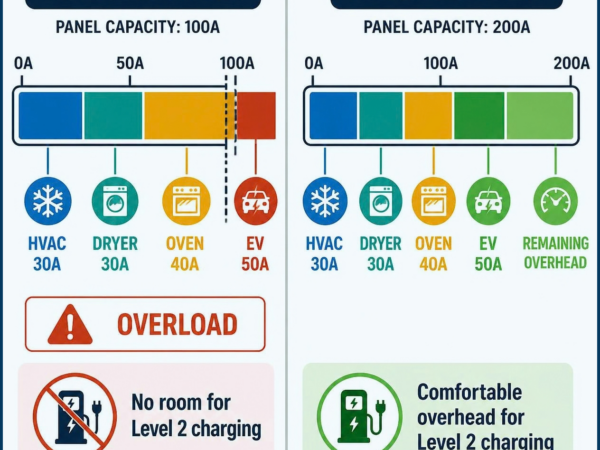
Over 90% of electric car charging happens at home overnight. To get those fast Level 2 speeds, you will need a 240-volt dedicated circuit installed in your garage or driveway. Every home’s electrical panel is different—some older 100-amp service panels may need a minor load adjustment, while newer 200-amp panels are often ready to go.
Working with high-voltage circuits requires precision to keep your home safe and fully compliant with local electrical codes. If you’re ready to make morning stops at the gas station a thing of the past, request a free home installation assessment from our master electricians. We’d love to chat and help you set up the perfect charger for your home.