
Buying an electric vehicle is an exciting milestone. You get smooth, instant power, zero tailpipe emissions, and best of all, the convenience of waking up Every morning with a “full tank.” But as many new EV drivers quickly learn, home charging brings one critical question: Can your home’s electrical panel actually handle a Level 2 charger?
If you’ve been charging with a standard 120V wall outlet (Level 1), you know it takes days to top off a battery. Upgrading to a Level 2 charger (240V) cuts that time dramatically—adding roughly 25 to 45 miles of range per hour. However, a Level 2 charger pulls more continuous power than almost any other appliance in your house.
There are 2 main factors to consider when determining if your home’s electric panel will support a level 2 EV charger:
SPACE & CAPACITY
- SPACE: Does your existing electric panel have additional slots available for a SCA electrician to add an additional 2-pole breaker? 2-pole = 2 slots one on top of the other.
- CAPACITY: Does your electric panel, as it sits now, have excess capacity to absorb the additional electric load for a lEVel 2 home EV charger? A detailed load calculation provided by SCA tackles this for you.
Here’s how to figure out if your panel is ready, how load calculations work, and what your options are if your system is running close to capacity.
The Basics: Understanding Amps and Load Calculations
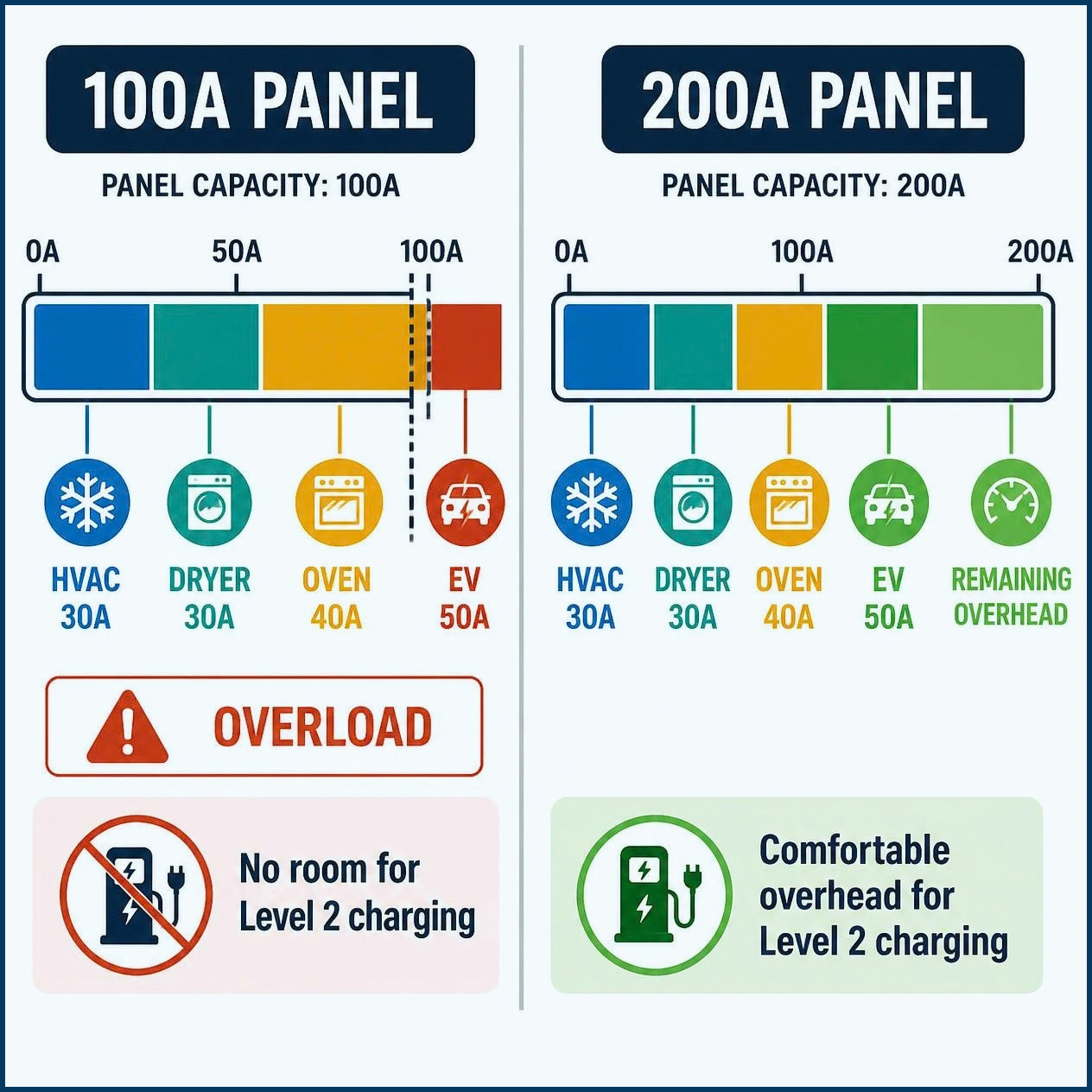
Your electrical panel’s size is measured in total amperage—typically 100 amps in older homes, or 200 amps in newer builds.
To determine whether your panel has room for a Level 2 EV charger, electricians don’t just count the physical open slots in your breaker box. We perform a formal NEC (National Electrical Code) load calculation.
A load calculation Evaluates:
- The total main service size coming into your home (e.g., 100A or 200A).
- The square footage of your living space.
- The continuous loads from existing heavy appliances (air conditioning, electric water heaters, dryers, ovens, and pool pumps).
Because EV charging is classified as a continuous load, most commonly electricians refer to the 80% rule where a 60A rated EV charger would dispense a max 48A continuous load to the EV, thus you would need to install a 60A circuit/breaker for your EV charger; 60A x 80% = 48A. If your home’s load calculation shows that your household peak demand, plus that extra 48 amp continuous draw, exceeds your main service rating, simply squeezing a new breaker into a spare slot creates a real safety hazard for the panel, home and family.
Do You Always Need a Panel Upgrade?
Before we answer that question we need to know the difference between an electric Panel Upgrade and a utility Service Upgrade.
- Panel Upgrade = Replacing the home’s existing main electric panel with a newer, often larger / more code compliant panel. These are generally performed when the home’s electric panel has enough Capacity to add the EV charger circuit, but not enough Space.
- Service Upgrade = Boosting the home’s existing power level from the utility company, e.g. upgrading the electric service from 125A to 200A. This option includes a full Panel Upgrade + a Power Upgrade from the utility company giving the home the much needed additional power to spread amongst the appliance loads. These are generally performed when the home’s panel does not possess enough Capacity, nor Space to add the EV charger circuit.
You may not need it now, but most homeowners contemplate electric panel or utility service upgrade options to absorb additional household appliance or accessory loads they plan on adding to their homes in the future, e.g. Pool/Hot tubs, Saunas, Work shops, multiple EVs, Mini Splits/additions, Casita’s, etc., so when considering adding a level 2 home charger, if add-ons like these and many more are on the horizon, it’s often not a common request to upgrade the service and panel to the home while we’re there. However, with newer technology at our fingertips and with the help of a SCA sales representative, while upgrading to a 200-amp main panel is a reliable long-term investment, it isn’t your only path forward.
Industry reporting from outlets like InsideEVs highlights that average drivers travel around 37 to 40 miles per day, meaning most daily recharges require relatively modest kilowatt-hours overnight. Depending on your driving habits and budget, we often recommend two practical alternatives:
- Lower Amperage Level 2 Charging: You don’t need a massive 60-amp circuit to get fast home charging. Installing a dedicated 20-amp or 30-amp 240V circuit yields 16A to 24A charging speeds, adding 15–20 miles of range per hour. That’s more than enough to fully restore a daily commute overnight without pushing a 100A panel over its limit. If your EV sits in the garage for 12 hours it shouldn’t matter if it reaches a full charge in 2 hours or 6 hours.
- Smart Energy Management Devices (load shedders): A dynamic load management system monitors your main electrical panel in real-time. If your electric dryer and air conditioner kick on simultaneously, the smart system automatically dials back or pauses the EV charger until power frees up—preventing breaker trips without requiring an expensive service upgrade from your utility provider.
Professional Safety First
Overloading an electrical panel or installing high-amp breakers without verifying total household load calculations can lead to nuisance breaker trips, melted insulation, or severe fire hazards. Ecery home’s wiring is a little different, which is why a proper site assessment by a licensed master electrician is essential before buying hardware.
Ready to find out what your home can handle? Schedule a professional site assessment with Smart Charge America today. We’ll perform an accurate load calculation, walk you through your best charging options, and get you set up safely.